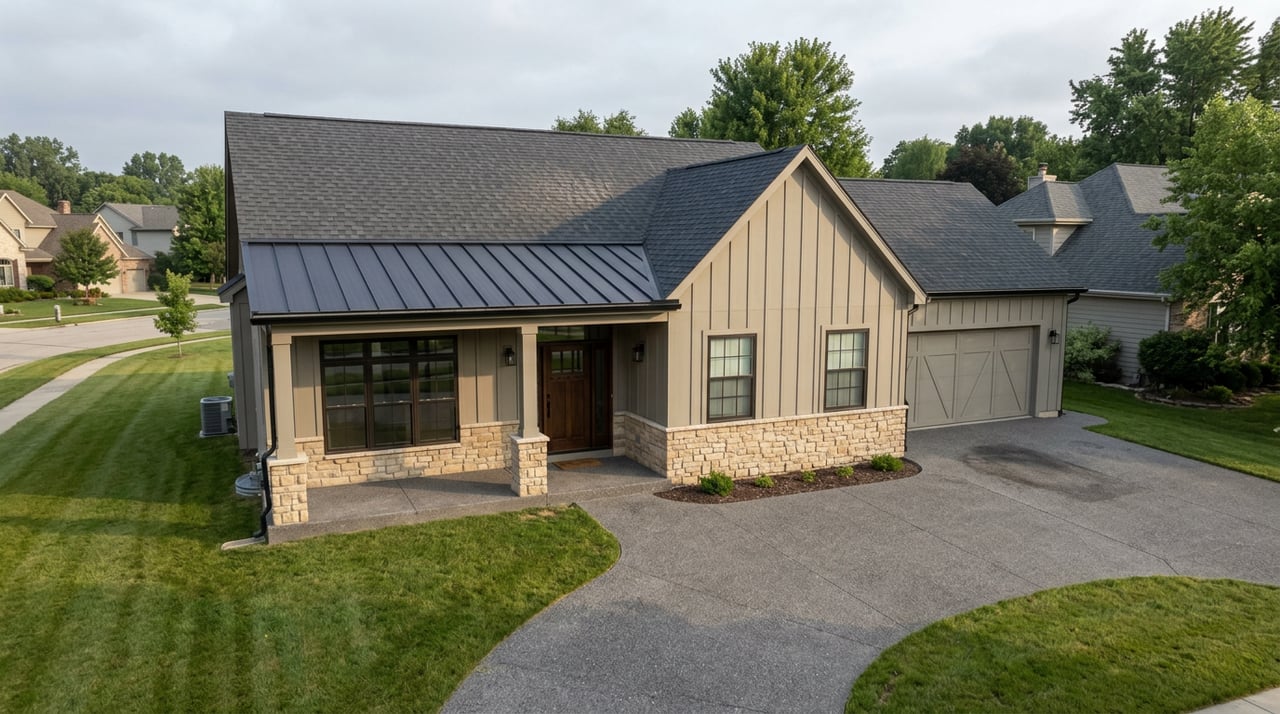
A Sacramento-region fee appraiser once documented a pair of new-construction units in the City of Lincoln that sat on opposite sides of a cement block wall separating two phases of the same development. Same builder, same floor plan, same year of construction. One side carried an active Mello-Roos bond. The other side didn't, because the developer had paid it off in full before selling those units. When the appraiser lined up the closed sale prices, the gap wasn't a rounding error. It ran more than 10 percent, purely because one side of the wall had a recurring tax obligation and the other didn't.
That story is the whole argument of this post. In Lincoln's newer neighborhoods, the Mello-Roos line on a tax bill doesn't move with what you paid for the house. It moves with the parcel, the square footage, and which side of an invisible district boundary the home happens to sit on. Two homes that look identical on a walkthrough, similar year built, similar floor plan, similar street, can carry monthly costs that differ by hundreds of dollars. Neither the sale price nor a lender's first ballpark estimate always catches it before you're deep into a transaction.
The Tax Follows the Parcel, Not the Price
Mello-Roos assessments aren't based on a home's market value. They're calculated by square footage, lot size, or a flat rate set when the district formed, and they sit outside the 2 percent annual cap that Proposition 13 places on standard property tax. That distinction matters more than it sounds like it should.
A fixed annual Mello-Roos charge on a given floor plan stays the same dollar amount whether that specific home eventually sells for $450,000 or $650,000. It also doesn't shrink as a share of value when the market moves up. The tax stays fixed, or adjusts only per the district's own escalation formula, regardless of what a buyer actually agreed to pay for the house.
Same builder. Same floor plan. Different bill.
That's the mechanism buyers routinely miss. A higher purchase price doesn't dilute a Mello-Roos payment the way a bigger down payment dilutes a loan balance. The special tax is attached to the structure and the district, not to the number on the purchase contract.
Where the Line Actually Runs in Lincoln
In Lincoln, the boundary tends to fall along build era. Twelve Bridges, built into Lincoln's rolling hillside terrain, and Lincoln Crossing, the flatter master-planned grid on the west side of Highway 65, both grew largely in the 2000s and both leaned on Community Facilities District bonds to fund the roads, sewer lines, and parks that came with rapid buildout. Catta Verdera, the gated golf community from roughly the same period, carries Mello-Roos on some phases and not others, since it was built out in stages over several years and each phase financed its infrastructure separately.
Older Lincoln, meaning the historic downtown grid and Foskett Ranch, mostly missed this wave. Those areas were largely built before CFD financing became the standard tool for funding new subdivisions, so a home there typically carries only the base 1 percent rate plus whatever voter-approved bonds apply countywide, without an added special tax layer on top.
That split is well known enough statewide that Lincoln Crossing shows up by name on lists of California's most Mello-Roos-dense communities, grouped alongside places like El Dorado Hills and Folsom.
| Area | Typical Build Era | Mello-Roos Exposure |
|---|---|---|
| Lincoln Crossing | 2000s, flat master plan | Common, often on the higher end |
| Twelve Bridges | 2000s-2010s, hillside master plan | Common |
| Catta Verdera | 2000s-2010s, phased golf community | Varies by phase and street |
| Foskett Ranch and Old Town | Pre-1990s and historic | Rare, or legacy bonds nearing payoff |
What a Few Hundred Dollars a Month Actually Does to Your Approval
Run the math and the stakes stop being abstract. A Mello-Roos bill of $3,600 a year adds roughly $300 a month to housing costs, and that $300 counts in a buyer's debt-to-income ratio exactly the way principal, interest, and base property tax do. Lenders don't treat it as optional or negotiable.
In California's CFD-heavy ZIP codes, effective property tax rates, meaning the base 1 percent plus every bond and special assessment stacked on top, can reach 1.5 to 1.7 percent of the purchase price. That compares with 1.1 to 1.3 percent in areas without a CFD. On a $500,000 home, that difference works out to roughly $460 to $540 a month in property tax outside a CFD, compared with roughly $625 to $710 a month inside one, before the mortgage payment even enters the calculation.
For a buyer stretching to qualify, that difference can decide whether a specific Lincoln address is affordable, independent of what the listing price says. Two homes priced identically at $520,000 can require different qualifying incomes if one carries a $150 monthly Mello-Roos payment and the other carries $450.
The Disclosure Gap Between New Construction and Resale
New construction makes this easy to see coming. California law requires a Public Report on new subdivision lots, so a Mello-Roos disclosure gets built into that paperwork before anyone signs a purchase agreement. Resale is where the gap opens. A Public Report isn't required on a resale, so the amount and duration of an existing bond isn't always sitting in plain view. Someone has to go looking for it.
State law does require full disclosure of the tax rate, projected increases, and remaining obligations once a property is confirmed to sit inside an active district. The friction isn't whether disclosure eventually happens. It's timing. A buyer who doesn't ask early can meet the number for the first time in a loan estimate, well after falling for the house.
Before writing an offer on a Lincoln home built after the 1990s, three things are worth confirming directly:
- The current year's tax bill, checked for a CFD line item through the county assessor's parcel lookup.
- The preliminary title report, which will show any recorded special tax lien tied to the parcel.
- The MLS listing's Mello-Roos field, cross-checked against the Seller's Transfer Disclosure Statement.
When those three don't match, that's the moment to request the CFD's engineer's report or Notice of Special Tax before moving further into escrow.
What This Means If You're Pricing a Home to Sell
Mello-Roos doesn't change what an appraiser writes down for the structure itself. It's a tax attached to the land and the district, not a physical feature of the home, so it won't show up as a line-item deduction on an appraisal. What it changes is the size of the buyer pool willing to write an offer, and that shows up in negotiated price rather than appraised value.
That's the real lesson in the wall story from the opening of this piece. Same builder, same floor plan, same street, and the market still separated the two sides by more than 10 percent once buyers ran their own carrying-cost math.
Some CFDs allow a homeowner to prepay the remaining bond before listing, either in full or in set increments, which removes the ongoing tax and can widen the pool of interested buyers. It isn't free. Prepayment typically requires paying the remaining principal in a lump sum, and not every CFD permits it outside specific windows. For an owner planning to sell within the next few years, a call to the CFD administrator to confirm whether prepayment is even available is worth making before assuming it is.
FAQ
Is Mello-Roos tax deductible? It's complicated. Standard property taxes based on assessed value are generally deductible, but Mello-Roos isn't an ad valorem tax, so the portion funding new construction typically isn't deductible. A portion funding ongoing maintenance or services may qualify in some cases. For 2026, the federal SALT cap rose to $40,000 from its prior $10,000 limit, which changes the calculation for some California homeowners. This is a question for a CPA familiar with California property tax rules, not something to assume either way.
How do I find out if a specific Lincoln address has Mello-Roos? Pull the current secured tax bill using the property's parcel number through the county assessor or tax collector, check the preliminary title report for a recorded special tax lien, and confirm against the Seller's Transfer Disclosure Statement and the MLS listing. If any of those disagree, request the CFD's Notice of Special Tax directly.
Does paying off Mello-Roos early guarantee a higher sale price? Not dollar for dollar. The appraiser's wall example showed a real market reaction, but the size of that reaction depends on the buyer pool, the neighborhood, and how much weight local buyers put on carrying costs at the time of sale.
None of this makes Lincoln's newer communities a poor choice. Twelve Bridges, Lincoln Crossing, and Catta Verdera offer construction and amenities that older Lincoln stock simply doesn't have, and plenty of buyers decide the tradeoff is worth it once they see the real numbers. The point is knowing what's on the tax bill before you're three weeks into escrow, not after.
If you're weighing a specific Lincoln address against the CFD status attached to it, or pricing a home to sell in a district where Mello-Roos is part of the story, Taylor Zapata can help you pull the actual parcel history and walk through what it means for your offer or your listing. Let's Connect.